
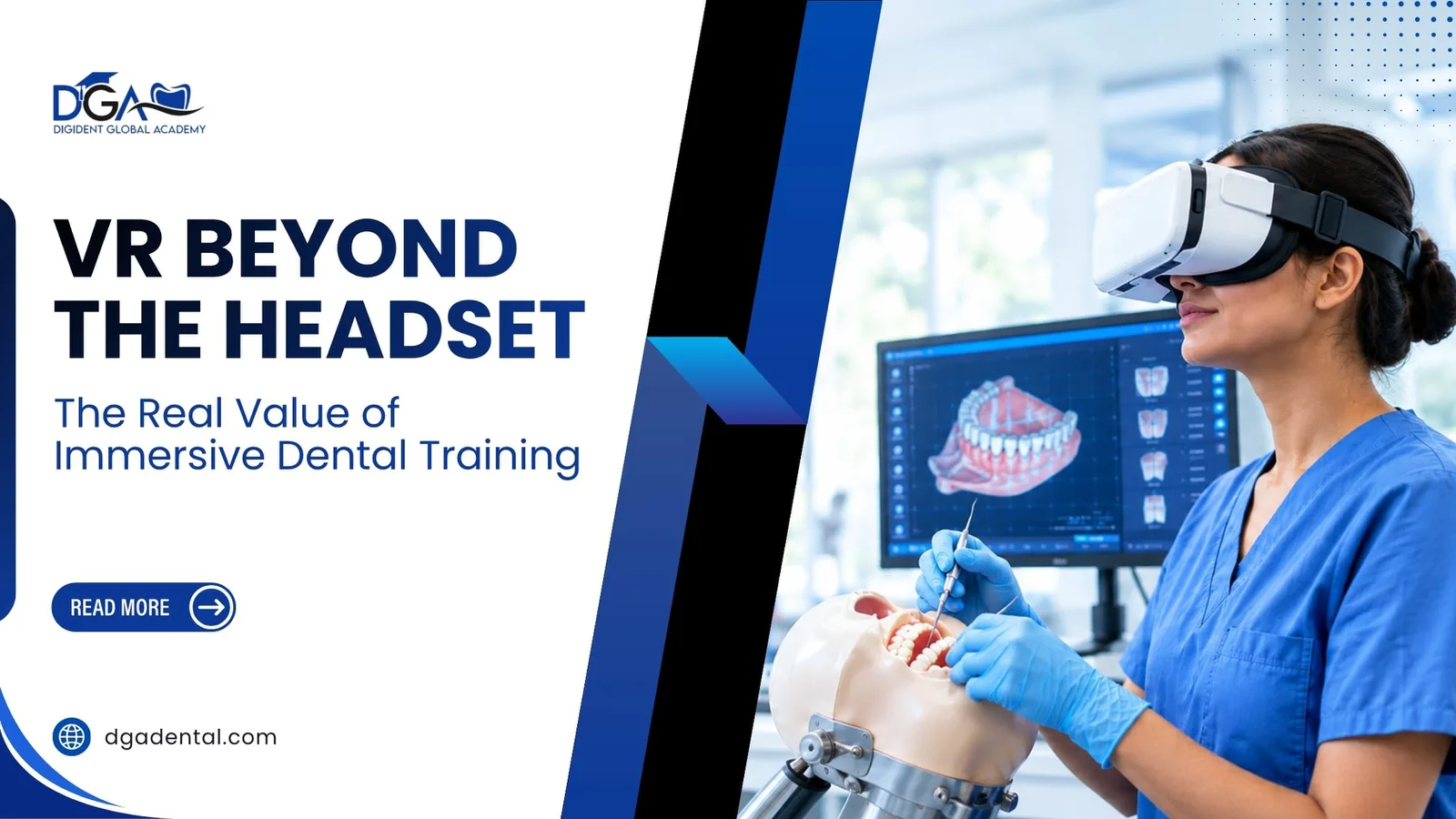
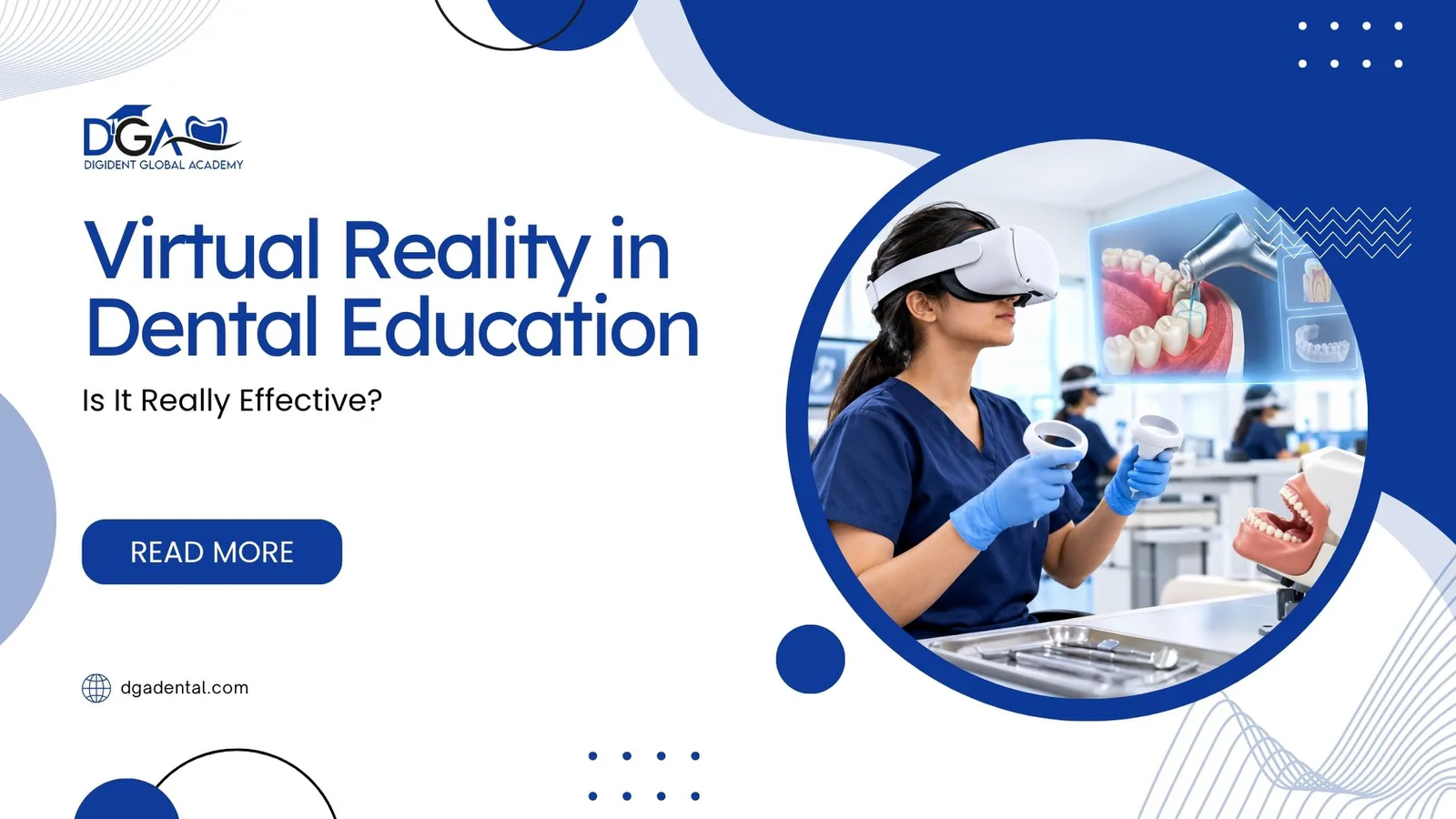
Put a VR headset on a dental student for the first time, and you get the same reaction almost every time. Eyes go wide, someone laughs, somebody mutters a quiet "whoa." Honestly, fair enough. It's a strange, slightly thrilling thing to strap on a headset and suddenly be standing over a virtual patient.
Give it a week, though, and that novelty is gone. The student stops noticing the headset entirely and just gets on with the procedure in front of them. That's usually the moment a program finds out whether it bought a toy or a training tool.
That's the real story of VR in dental education. Not the device. The system underneath it.
The headset is the least interesting part
A lot of buyers evaluate VR training the way they'd evaluate any new gadget: resolution, comfort, battery life, whether it fogs up mid-session. Those things matter, sure, but they're the easy part. Two programs could hand a student the exact same Meta Quest headset and still end up with completely different training, because the headset was never the thing doing the work.
What actually matters comes down to three questions: what can this person practice, is their performance actually being tracked, and what happens to that information once the headset comes off. Take those three things away and what's left is a fairly expensive way to stare at 3D teeth.
This distinction matters more than it might seem, because it changes the entire conversation a buyer should be having. The question isn't "does this look realistic?" The question is "does this produce a clinician who performs better on day one?" Those are very different evaluation criteria, and most VR pitches only answer the first one.
Practice: repetition without a ceiling
Traditional dental training runs on scarcity. A student gets limited chairside hours, a handful of real patients, and maybe one shot at a full-arch case before graduation. Faculty would love to give more one-on-one feedback than that. There just aren't enough hours in a semester to make it happen.
Physical simulation labs help, up to a point. Consumables run out. Mannequins wear down. Lab time gets scheduled in blocks, not offered on demand. If a student wants one more attempt at 9 pm the night before an exam, they're out of luck.
VR removes that ceiling. A student can run a crown prep, an endodontic access cavity, or a full-arch implant placement as many times as it takes, at 11 pm, on a Sunday, with no supervisor in the room and no consumable used up. No patient at risk, no waiting on an open operatory.
That's not a minor convenience. Rehearsing a procedure twice and rehearsing it fifty times are two different kinds of preparation. The fiftieth rep tends to be where real confidence shows up, not the first.
Assessment: turning a hunch into a number
Repetition on its own isn't enough, though. Plenty of training methods let someone repeat a task badly, over and over, and walk away no more competent than when they started. Practice without feedback just cements bad habits faster.
This is where two distinct modes matter:
- Guide Me. A coached walkthrough where the student is still learning the motion, not being graded on it. This is where mistakes get caught while they're still easy to fix.
- Test Me: the coaching disappears, and the attempt gets scored objectively against a standard. No hints, no safety net, just a real result.
Guide Me builds the habit. Test Me proves it happened. One tells a student, "You've watched this enough times." The other tells them, "You can actually do it," and only the second one holds up when someone asks for evidence: a licensing board, an accreditor, a lab manager sizing up a new hire.
Measurable performance: the part buyers actually pay for
This is the part that actually matters to a buyer, and it looks different depending who you're talking to. It's also the part most sales conversations skip past, because it's a lot easier to talk about how immersive something feels than to talk about whether it actually worked.
Take dental schools. What they need isn't a good feeling about a VR program, it's paperwork. Accreditors want to see that a student actually practiced a given procedure to a real standard, not just take a professor's word that it happened sometime last semester. A scored session sitting in an LMS does that job on its own. It's dated, it's auditable, and it doesn't depend on which faculty member happened to be in the room that day.
Dental labs care about a more direct number: remakes. A bad scan from a referring office costs a lab real money and real turnaround time. If training cuts down on scanning errors before they ever reach the lab, that shows up on a P&L, not just a report card. It also affects which cases come back at all. Labs that close the confidence gap on scanning tend to see more full-arch and denture work flow their way, instead of watching it go to a competitor.
Manufacturers watch a different metric: utilization. A scanner or implant system a clinician doesn't fully understand becomes shelfware fast, and shelfware is where churn starts. In-person, instructor-led training is the traditional fix, but it's expensive per seat and doesn't scale past a handful of markets a year. Structured, scored practice on the real workflow keeps a purchased system in active use instead of sitting in a drawer between reorders.
DSOs are tracking ramp-up time and consistency across locations. New hires who've already scored well on a procedure in VR need less hand-holding on their first real cases, and that kind of consistency is hard to build any other way across a group running 30, 50, or 100 locations with no in-house training department to lean on. It also means more high-value cases, implants, and full-arch work- especially staying inside the DSO instead of getting referred out because the treating dentist isn't confident yet.
Different buyers, same underlying idea: data replaces guesswork.
"But is it actually as good as real training?"
This is the objection every VR training conversation eventually runs into, and it's a fair one to raise. Nobody wants to bet a curriculum, or a new hire's competence, on a gimmick.
The honest answer is that VR isn't trying to replace chairside experience. It's what happens before it. Aviation and surgery already settled this question decades ago: pilots log hundreds of simulator hours before they ever sit in a real cockpit, not because the simulator replaces flying, but because it means their first real flight isn't also their first attempt at flying. Dental training is simply catching up to something other high-stakes fields figured out a long time ago.
The more useful question isn't "does VR replace hands-on training?" It's "does a student who's rehearsed a procedure fifty times in VR perform better on their first real attempt than one who hasn't." That's a testable claim, and it's worth asking any vendor to answer it with actual scored data, not marketing language.
What this actually looks like in practice
In practice, this means training modules built around real systems, not generic stand-ins. Scanning workflows on iTero and TRIOS. Implant procedures on Straumann systems. Sterilization, endo assisting, crown finishing: the everyday work that makes up most of a career, alongside the high-stakes procedures that make up the riskiest part of it.
It also means every session, every rep, every score, feeds into an LMS a program director or lab manager can actually look at. Not a vague sense that "training happened," but a record of who trained on what and how they performed, searchable and exportable whenever accreditation season or an internal audit rolls around.
Why the source of the content matters
None of this works if the procedures inside the headset are wrong, or built by someone who's never actually done them. A lot of dental ed-tech comes out of software studios working from textbooks and video references. It looks polished. It doesn't always hold up against how a procedure actually feels in someone's hands, and clinicians pick up on that gap almost immediately.
Content built by a practicing dentist, someone who's spent two decades doing the work and understands the digital and CAD side of it too, closes that gap. The workflows map to what a clinician will actually see in a real operatory, not a secondhand approximation of it.
The takeaway
The headset isn't the innovation. It's the delivery mechanism. The real shift in dental education is what's running underneath it: unlimited practice, honest assessment, and performance data that a school, a lab, a manufacturer, or a DSO can actually act on.
If your team is still evaluating VR training by how it looks in a headset, that's the wrong question. Ask what it measures instead.
See it on your own workflow
The clearest way to judge any of this is to watch it run on a procedure your team actually does, not a generic demo case.
Book a 20-minute demo, and we'll walk through Guide Me and Test Me on a module relevant to your program, lab, or system: iTero, TRIOS, Straumann, or your own workflow, so you can see exactly what gets measured and how the data comes back to you.
Comments
No comments yet
Be the first to ask a question about this technique.