
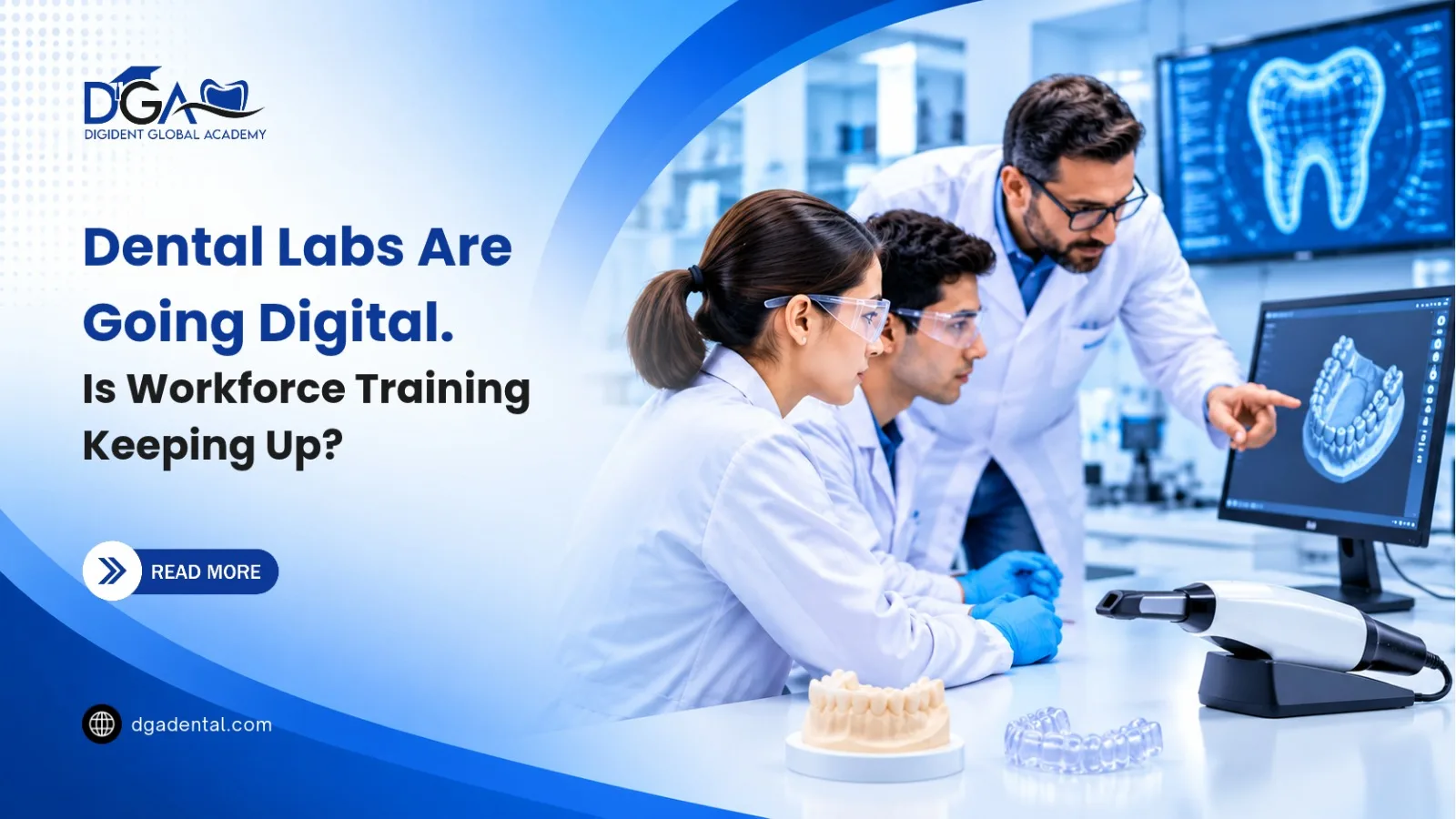
Picture a dental lab on a Tuesday morning. The new printer arrived a few weeks ago, and the design software license was renewed last month. The senior technician has spent more than twenty years at the bench, with hands that can wax up a molar without looking, and right now he's staring at a scan that came in overnight from a partner office.
There's a gap near the last molar. The margin on one prep is hard to read, and the surface has a faint ripple where the images didn't quite stitch together. The case is due Friday. The dentist is with patients all morning and won't pick up the phone. He can work around the problem and hope, or he can ask for a rescan and lose a day. Either way, the lab is about to spend time and money on something that started before the file ever reached them.
Nobody in this story is careless. The equipment is excellent, and the people are skilled. What's missing is something less visible: enough practice with the new way of working, on both sides of the file.
What changed on the lab bench
Not long ago, a lab's day started with a box of impressions and a tray of stone. Plenty of labs now start with a digital file. Restorations get designed in CAD software and then milled or printed, and the person who once shaped wax now spends a good part of the day at a screen. Digital scanning at the office, CAD/CAM design in the lab, and fabrication from a mill or printer have become one connected workflow instead of three separate steps.
That's good news for speed and consistency. It also quietly changes what a skilled technician needs to know. Judging a margin on a screen is a different skill from judging it on a die. Designing a bridge in software draws on the same dental knowledge, and it adds a new layer of tool skill on top. The best technicians are the ones who can do both, and that takes time nobody put on the schedule.
For a lab owner, there's a second shift underneath this one. Equipment is a capital decision and skills are a people decision, and the two rarely get planned together.
Who's teaching the new skills?
Technology moves faster than most training does, and the pattern shows up in the research. In a Korean survey of 295 dentists, hygienists, and dental technicians, 75.3% had used digital intraoral scanners. Among those who had received scanner training, only 20.7% got it at a university, and 90.8% said a university-level curriculum on the technology is necessary. Whatever training people got, most of it happened somewhere other than school.
Schools are working on it, with uneven results. A survey cited in a national study found that over 90% of North American dental schools use CAD/CAM somewhere in their undergraduate programs, yet digital dentures lag well behind. One study found that only 12% of US dental schools had added digital denture fabrication to their undergraduate curriculum, and a UK study found that 55% of dental schools weren't teaching digital dental technology to undergraduates at all. When schools were asked why, the answers were practical: 78% said it wasn't in the curriculum, 66% pointed to a lack of expertise, 44% to untrained faculty and staff, and 33% to cost.
For a lab, this matters twice. The people designing restorations picked up their digital skills mostly on the job. And the dentists sending scans picked up theirs the same way.
Two sides of the same file
A lab can't scan for the office, which is the uncomfortable part. A bad scan from a partner practice often means a remake, and remakes are expensive in ways that don't show up on an invoice: bench time, material, shipping, and a strained relationship with the office. Anyone who has watched a lab's margins wear thin from remakes knows the pattern.
Scanning mistakes also travel. In a digital denture or full-arch workflow, the scan is where everything starts, and the design and fabrication that follow all depend on how good that first capture was. For full-arch cases, clinicians often point to the posterior maxilla and mandible as the hardest areas to capture accurately. A small problem at the start becomes a poor fit at the end, and the person who finds it is usually the technician holding the file.
Labs often know exactly which offices send the files that cause trouble. That knowledge is useful, and it rarely turns into anything more than a phone call.
So when a lab thinks about workforce training, it can't stop at its own walls. The quality of what comes in matters as much as the quality of what goes out.
Why the training stalls inside the lab
Labs have their own reasons for training slides. Production runs on deadlines, and the most experienced technician is also usually the busiest one. Practising on live cases means mistakes cost real material and real turnaround. Pricing pressure makes it harder still, because every hour spent on training is an hour not spent on billable work.
Imagine asking that senior technician to step away for two hours of practice on a Wednesday. The case queue doesn't shrink while he's gone. Somebody else absorbs it, the day gets tighter, and the next time the idea comes up it's even harder to say yes. Practice loses to the schedule one reasonable decision at a time.
Then there's the opportunity on the other side of the ledger. High-value work like full-arch cases, All-on-X restorations, and digital dentures can end up going elsewhere when referring offices don't feel confident handling them. A lab that can help those offices get better at scanning and at digital workflows has a chance to keep that work close, and to turn an expensive pattern of remakes into a stronger relationship.
What keeping skills aligned looks like
Keeping a team current with new processes is mostly about giving people a place to practice before the work counts. A lab or an office adopting a new workflow could aim for a few simple things.
- Time to practice on non-live cases, protected on the schedule
- Feedback specific enough that someone can change what they do next
- A way to see who has practiced what, and how they did
- Rehearsal for the hard workflows before they show up on a real case
- The newest team members included from the first week
The feedback piece matters more than people expect. A University of Leeds study in the European Journal of Dental Education put novice trainees into three groups, one with only simulator feedback, one with only instructor feedback, and one with both. The group with both made fewer errors, performed better, and still showed the skill a month later. Practice helps, and practice with good feedback helps more.
Where VR simulation fits
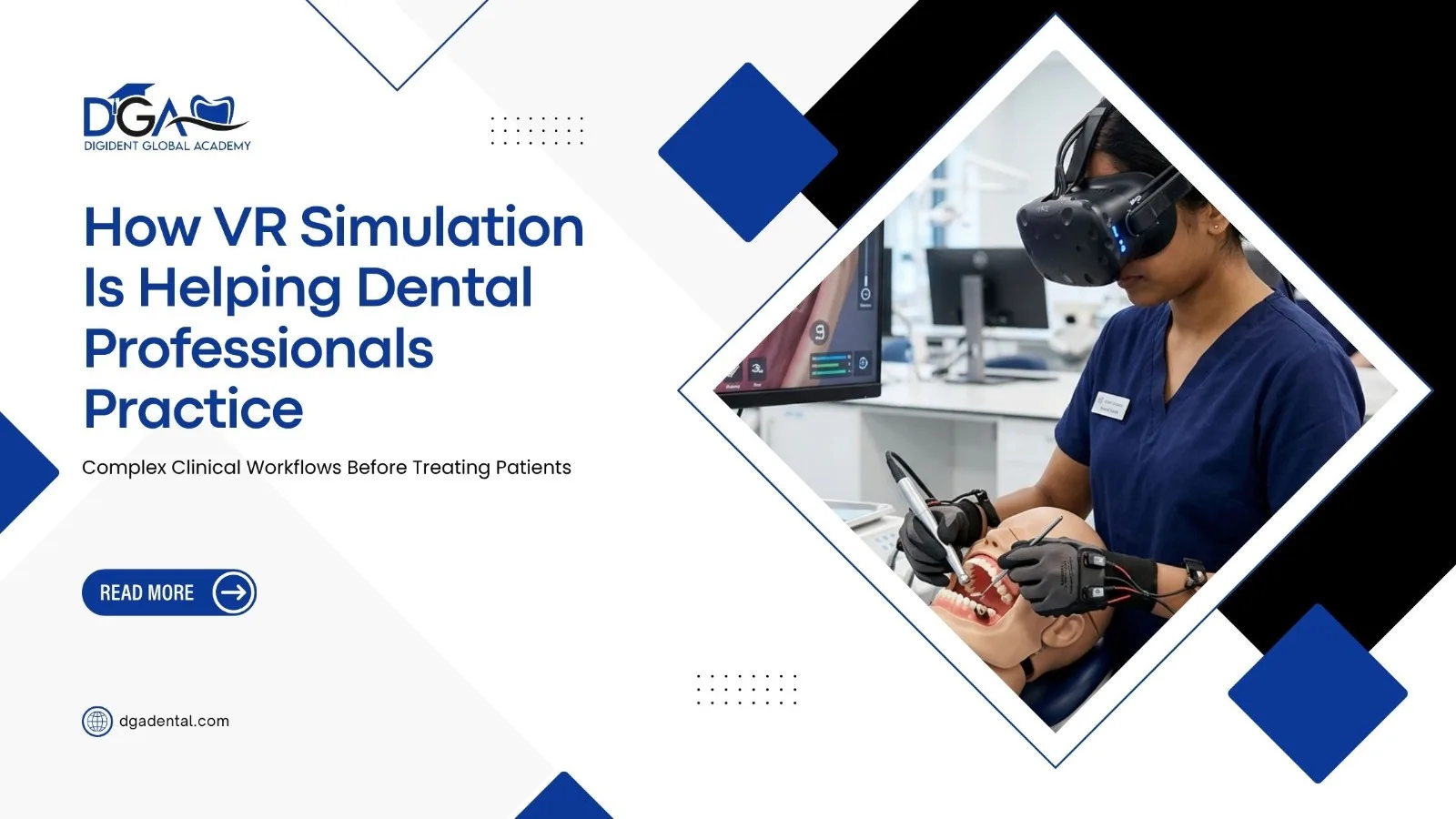
This is where DigiDent Global Academy comes in. DGA builds VR training for dental professionals, and its modules cover scanning on iTero and TRIOS, along with implant and denture workflows, including digital dentures, Zest overdentures, and full-arch work on Straumann's Smart-on-X and Nexus All-on-X systems. A practising dentist built and vetted the content, so what a learner practices matches what happens in a real operatory.
Guide Me gives a learner a coached walkthrough, so early mistakes happen where they cost nothing. Test Me takes the coaching away and scores the attempt against a fixed standard, which gives a lab or a practice an honest answer about whether someone can do it without help. Every session logs to an LMS, so a lab manager can see who practised what and how it went.
For a lab, that points in two directions. It gives your own team a way to rehearse new digital workflows without risking live cases, and it gives you something to offer the offices you serve: a way to improve the scans that arrive at your door. DGA has worked with Leixir Dental Labs, an East Coast lab, and labs are one of the partners the platform is designed around.
Back to the technician staring at that scan. Suppose the partner office had practised scored scans before sending their first full-arch case, and suppose his own team had rehearsed the denture design workflow in advance. The gap near the last molar probably wouldn't be there, and if it were, someone would know exactly what to ask for. That's a very different Tuesday.
What simulation doesn't do
VR practice doesn't replace the bench. A technician's eye, honed over years of looking at real restorations and real materials, still decides whether something is right. Simulation also doesn't replace scanning real mouths, where saliva, movement, and soft tissue vary in ways no headset fully reproduces. What practice does is raise the starting point, so the people involved arrive at real cases having done the hard parts many times.
Questions to ask in your own lab
A few are worth raising at the next team meeting.
- How did each person on your team learn the digital workflow they use, and how much of it was trial and error?
- Which scans from partner offices cause the most rework, and could a short practice program help those offices?
- When you bring in a new process, how much rehearsal does the team get before it's used on a live case?
- Can you see who is confident with which workflows, or are you relying on a feeling?
The takeaway
Digital dentistry has already reshaped what labs do all day. The equipment arrived on schedule, and the skills are still catching up, in the lab and in the offices that send work through. The labs that close that gap first will probably be the ones that treat practice time as part of adopting a new process, and not as something to squeeze in when the schedule allows.
Want to see how your team, or the offices you serve, could practice before the work counts? Book a 20-minute demo, and we'll walk through Guide Me and Test Me on a scanning or digital denture workflow built around the systems you use.
[Book your 20-minute demo →]
Meta Title
Dental Labs Are Going Digital: Is Workforce Training Keeping Up?
- Length: 62 characters (Optimal: 50–60 characters)
- Key Focus: Clear, intriguing question that directly targets the core theme of digital adoption vs. workforce readiness in dental labs.
Meta Description
Explore how digital workflows are transforming dental labs, why training lags behind, and how VR simulation bridges the gap between labs and clinical practices.
- Length: 158 characters (Optimal: 150–160 characters)
- Key Focus: Highlights the core conflict (digital adoption vs. training gaps), mentions key solutions (VR simulation, cross-collaboration), and encourages clicks from dental professionals.

Comments
No comments yet
Be the first to ask a question about this technique.