
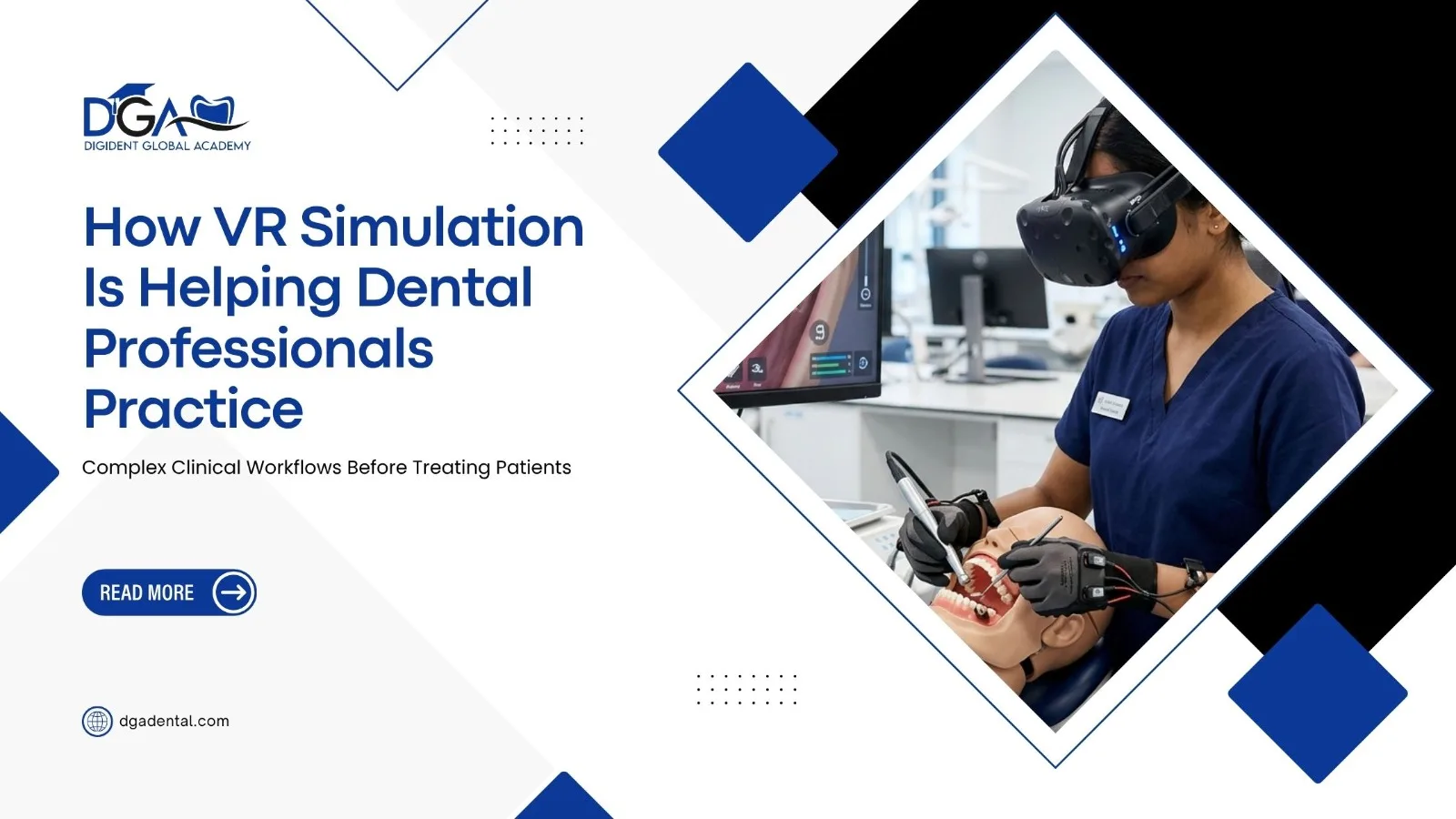
There's a particular kind of nervous that shows up right before a dentist's first real full-arch case. Not the everyday jitters, something heavier. You've reread the protocol twice. You've replayed the course recording again, maybe more than once. And you're still standing there about to do, for real, something you've only ever done on paper. That gap between knowing the steps and trusting your own hands to actually run them is where a lot of dentists get stuck. It's also the exact gap VR simulation is starting to close.
Why these workflows are so unforgiving in the first place
Full-arch implant cases. Digital denture fabrication. Guided surgery. Not one-step procedures. Not even close. A full-arch case means scanning the mouth, recording how the jaws actually come together, planning out where every implant will go, building a surgical guide from that plan, placing the implants with the guide in hand, and then living with a provisional restoration for weeks before the final piece ever gets made. Skip a beat anywhere along that chain, or just rush through one part of it, and you usually don't find out right away. You find out later, when it's a lot more expensive to fix.
Scanning tends to be where things go wrong first. Ask around and clinicians will point to the same two spots almost every time, the posterior maxilla and the mandible, as the places accurate capture gets genuinely hard. A bad scan back there doesn't stay contained to one problem. It follows the case downstream, through planning, through the guide, into surgery. That's just how a chain like this behaves. A small slip at step two turns into a real headache by step seven.
How dentists have traditionally learned this
Right now, most of this training happens through weekend continuing education courses. Live patient demos, hands-on workshops, sometimes watching one full case worked start to finish while a room full of other dentists looks on. These courses are genuinely valuable, and the good ones are taught by clinicians who know their craft. They're also expensive, often running into the thousands of dollars, and they usually leave a dentist with one, maybe two, supervised attempts before sending them home to do it for real on their own patients.
One attempt, or even five, doesn't go far when a workflow has this many steps depending on each other. And a live demo in a lecture hall doesn't let you pause, back up, and rerun the scanning sequence right after watching a bad angle wreck the whole plan.
Where VR actually changes the equation
This is the part that genuinely shifts something, not just a nicer way of describing the same idea. A VR module lets a dentist run the full sequence, scanning, planning, guided placement, the provisional, over and over, as many times as it takes. No patient in the chair. No lab bill piling up. No room full of colleagues watching a mistake happen live.
DGA's modules are built around the systems dentists actually use for this work. Scanning practice runs on iTero and TRIOS. Implant workflows cover Straumann's Smart-on-X and Nexus All-on-X systems. There's digital denture fabrication and Zest overdenture procedures too. None of this is a generic stand-in dressed up to look relevant. It's built to match the specific tools a dentist will actually pick up in their own operatory.
The structure underneath matters as much as what's in it. Guide Me mode walks a dentist through the sequence with real-time coaching, useful for actually finding where the pitfalls sit in a scan or a guide placement before they cost anything. Test Me mode takes that coaching away and scores the whole attempt cold, so a dentist gets an honest answer to the question that actually matters: could they run this unsupervised, not just recite the steps back.
Why this matters beyond the individual dentist
A workflow that goes wrong doesn't just cost the treating dentist time. A bad scan or a poorly planned full-arch case often turns into a remake at the lab, and that costs real money and turnaround for a partner the dentist depends on every week. Sometimes it means the case gets referred out entirely, simply because the dentist doesn't yet trust their own hands on something this involved. Enough rehearsal to build that trust keeps more high-value work in-house instead of walking out the door to a specialist down the street.
For dental schools and DSOs bringing newer associates up to speed, there's a documentation side to this too. Every scored attempt logs into an LMS, which means a program director or clinical lead can actually see whether someone has run a full-arch sequence successfully more than once, instead of going off a single supervised session from months back.
The takeaway
Complex clinical workflows fail for a specific, fixable reason. Not enough safe repetition before the real thing. Weekend courses and live demos still have a place in this. They were just never designed to give a dentist unlimited attempts at a multi-step sequence with real stakes attached to getting it wrong. VR simulation fills exactly that gap, on the actual systems a dentist will use, scored and tracked, so the first real full-arch case isn't also the first time the whole sequence has gone right from start to finish.
Want to see this on a workflow your team actually runs? Book a 20-minute demo and we'll walk through Guide Me and Test Me on a full-arch or digital denture sequence built around your systems.
[Book your 20-minute demo →]
Comments
No comments yet
Be the first to ask a question about this technique.