

Picture a dentist, two years out of dental school, on an ordinary Tuesday. Her next patient has worn the same set of dentures for eleven years and has had enough of them. A friend got digital dentures last spring, he says, and the whole thing took a couple of visits. Can she do that here?
She wants to say yes. The practice has a scanner. The lab down the road does digital work. On paper, everything she needs is in the building.
But she's only ever scanned a few arches in school, mostly a typodont, mostly with someone standing nearby. And digital dentures? That came up in one lecture. She remembers a slide.
So she does what a lot of careful dentists do. She says she'll look into it, and sends him home with a brochure.
That small moment, repeated in operatories everywhere, is the gap this article is about.
The profession moved. The curriculum is still catching up.
Digital dentistry stopped being a someday thing a while ago. One survey, cited in a national study of dental schools, found that more than 90% of North American programs use CAD/CAM somewhere in their undergraduate curriculum. Read quickly, that sounds like a finished story.
It isn't. Dig into the same paper and the story gets patchier. A UK study it cites found that 55% of dental schools weren't teaching digital dental technology to undergraduates at all. And when researchers look at which digital tools get taught least, digital dentures keep landing at the bottom. One study put the number at 12% of US dental schools that had brought digital denture fabrication into their undergraduate programs.
Researchers at Harvard and the Arizona School of Dentistry and Oral Health end up in the same place. Digital removable prosthodontics, especially CAD/CAM complete and partial dentures, trails further behind than the rest, they write, and there's surprisingly little published on how schools are actually fitting these tools into the curriculum.
So patients are asking, the technology is on the shelf, and the training in between is thin.
Scanning and dentures are rungs on the same ladder
It's easy to file intraoral scanning and digital dentures in two different drawers. Scanner: a gadget you learn once. Dentures: a whole other discipline.
They're really one ladder. The scan is where a digital denture starts, and everything after it, design, fabrication, try-in, delivery, leans on how good that first capture was. A stitching error or a missed border doesn't wave a flag. It slips quietly down the line and turns up later as a poor fit, a remake, or a patient who's back in the chair and not happy.
That's why teaching one without the other leaves a hole. Someone who's scanned plenty but never watched a scan become a denture design doesn't know what "good enough" actually looks like. Someone who's only seen the denture workflow on a slide has never felt how easily that first step goes wrong with a real patient and a clock running.
The scan isn't a box to tick. It's what everything else gets built on.
Why schools aren't just adding it
Before blaming anyone, it helps to ask why schools hold back. A national survey of Saudi dental schools asked exactly that. Among the schools that hadn't added digital technology, 78% said it simply wasn't part of the curriculum. Two thirds pointed to a lack of expertise, 44% to untrained faculty and staff, and a third to cost.
Look at what's missing from that list. Nobody said digital dentistry wasn't worth teaching. The obstacles were mostly everyday things. Not enough people who know how to teach it, not enough hours or equipment, not enough budget. A study of one UK dental school came back with the same list: infrastructure, staff training, and the awkward business of fitting digital work in alongside the conventional techniques students still have to learn.
You've heard this one before. Everyone agrees it matters. Nobody has the spare hours.
The people in practice are saying it too
It's the same story outside the schools. A survey of 295 dentists, hygienists, and dental technicians in Korea found that 96.3% knew about digital intraoral scanners, and 75.3% had actually used one. Here's the part that jumps out, though. Among the people who'd been trained on scanners, only 20.7% got that training at a university. And 90.8% of respondents said a university course on this stuff is necessary.
So a lot of people are picking it up on the job, at vendor sessions and weekend courses and by trial and error, and nine in ten say it belongs in school.
So what would better training look like?
You don't have to rip up the curriculum to fix this. What students and new clinicians need is easy to say and hard to get: plenty of practice with nothing at stake before a real patient is in the chair.
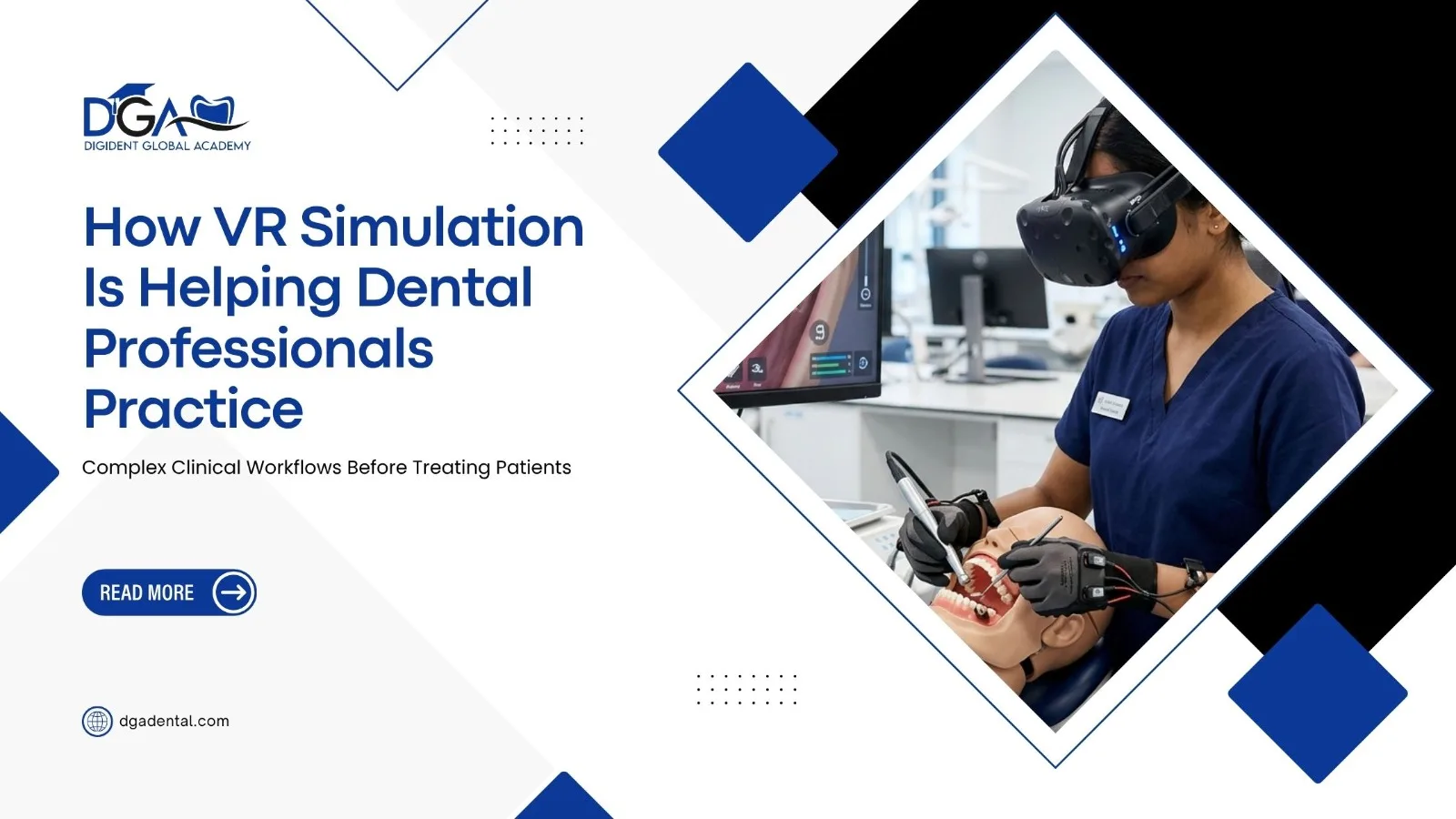
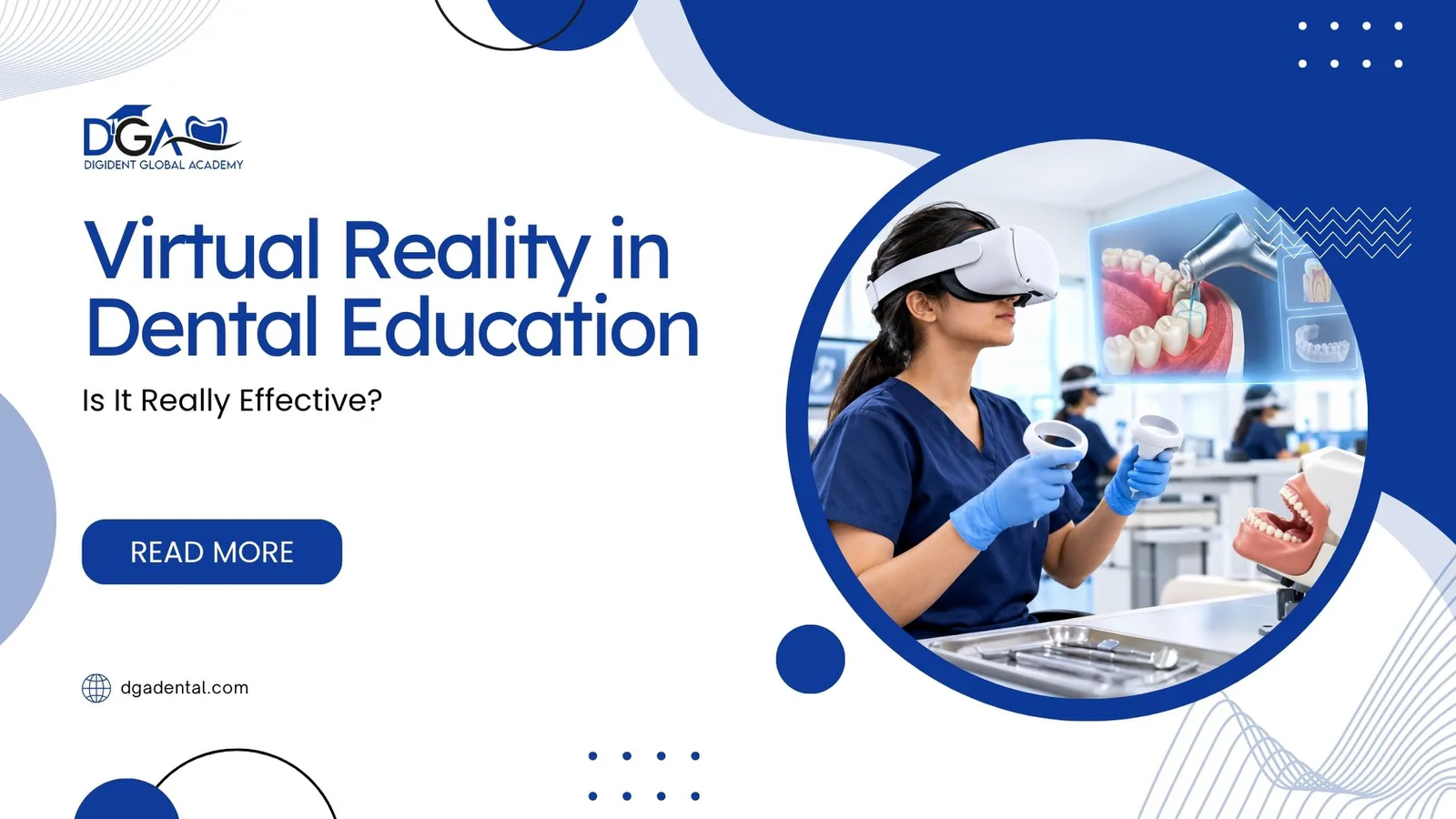
That's a job VR does well. At DigiDent Global Academy, scanning practice runs on the same systems clinicians use every day, iTero and TRIOS, so what a learner's hands pick up in the headset carries over to a real operatory. The library goes past scanning too: digital dentures, Zest overdentures, and full-arch work on Straumann's Smart-on-X and Nexus All-on-X.
It works in two modes. In Guide Me, the learner is coached through each step as it happens, so the early mistakes cost nothing. In Test Me, the coaching is gone and the attempt gets scored against a fixed standard. For digital skills, that's something most schools and practices don't have: a real answer to whether someone can do this without help. Each session logs to an LMS, so a program can see who practiced what and how it went.
Go back to the dentist from the start of this piece for a second. Say she'd run through a digital denture case a dozen times before she graduated, scan to delivery, with a score after each one. Now when her patient asks about digital dentures, she doesn't hand him a brochure. She pulls up her calendar.
What doesn't change
None of this replaces real clinical experience, and it shouldn't. Dentists are made by supervised work on actual patients, and a scanner in a real mouth doesn't behave like one in a headset. Good programs will keep teaching it that way.
What simulation changes is how many reps a student already has when they get to that point. In a field that's moving this fast, that's the thing to fix first.
The takeaway
Digital dentistry is already part of everyday practice. Plenty of cases now start with a scan and end with a finished prosthesis. If training treats that as an elective, one lecture, or something to sort out after graduation, new dentists are left to learn the hardest parts by themselves.
It's fixable, just not overnight. Give people real repetition, honest feedback, and some proof of progress early on, and start with the scan, because everything else depends on it.
Want to see how this could work for your program, practice, or lab? Book a 20-minute demo and we'll walk you through Guide Me and Test Me on a scanning or digital denture workflow built around the systems you use.
[Book your 20-minute demo →]
Meta Title: Digital Dentistry Training: From Scanning to Digital Dentures
Meta Description: Explore how VR simulation helps dental students and clinicians practice intraoral scanning and digital denture workflows with guided training and skills assessment.
Comments
No comments yet
Be the first to ask a question about this technique.